The eco-friendly washing up liquid market in Ireland is no longer a niche health-food store exclusive. Major retailers like Dunnes Stores, SuperValu, and Tesco now stock multiple "green" alternatives on their main shelves. However, the environmental performance and ingredient integrity of these products vary wildly. We chemically audited the formulas, analyzed surfactant safety, assessed local sourcing, and field-tested seven brands in Irish hard water to find what actually works without harming our waterways.
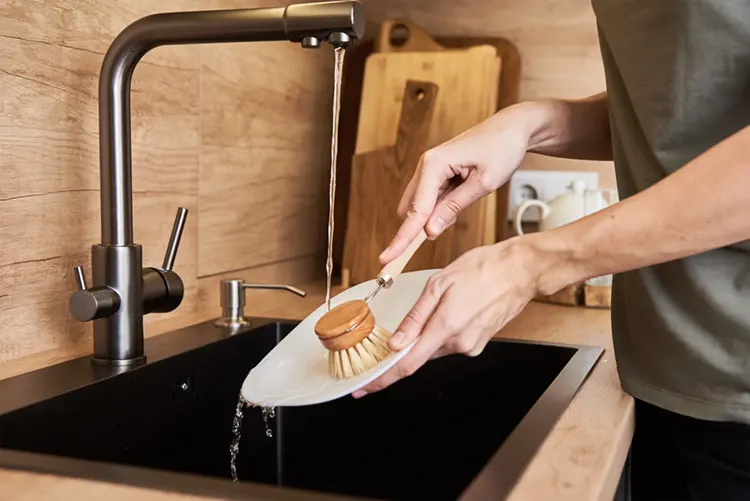
The Environmental Problem with Standard Dish Soap
Traditional washing up liquids are formulated to cut grease fast and create massive amounts of long-lasting foam. To achieve this, conventional brands rely on petroleum-derived surfactants like Sodium Laureth Sulfate (SLES) and Sodium Lauryl Sulfate (SLS). While highly effective at stripping grease, these compounds require energy-intensive fossil-fuel processing and present risks of containing trace manufacturing impurities like 1,4-dioxane.
More critically, conventional dish soaps frequently rely on synthetic colorants, persistent artificial musks, and aggressive biocide preservatives like Methylisothiazolinone (MIT) and Benzisothiazolinone (BIT). These preservatives are highly toxic to aquatic life with long-lasting effects, resisting typical wastewater treatment processes and building up in local river ecosystems.
---The Eco Certification Hierarchy: Cutting Through Greenwashing
With "plant-based" and "natural" claims plastered across almost every bottle, independent certifications are the only way consumers can separate genuine eco-chemistry from pure marketing.
1. EU Ecolabel (The Reliable Baseline)
The EU Ecolabel "Flower" is the gold standard baseline for products sold in Ireland. To earn this, a brand must prove to independent auditors that all surfactants are fully biodegradable under both aerobic and anaerobic conditions (passing strict OECD 301 test standards). It also places strict limitations on aquatic toxicity, packaging-to-liquid weight ratios, and bans aggressive sensitizing preservatives like MIT entirely.
2. Ecocert COSMOS Natural
COSMOS standard goes a step further by mandating that a high percentage of the raw ingredients are sourced from organic farming, strictly banning any genetically modified crops, and requiring fully traceable, environmentally responsible manufacturing practices. This is typically found on premium, clinical-grade eco products.
Top 5 Eco-Friendly Washing Up Liquids in Ireland (Ranked)
We evaluated these brands based on three pillars: **chemical safety (toxicology)**, **cleaning performance in hard water**, and **packaging circularity (including local refill availability in Ireland)**.
1. Bio-D Washing Up Liquid (Overall Winner)
Standard Price: ~€4.50 for 750ml | Certifications: Ecocert, Vegan Society, Allergy UK
UK-manufactured Bio-D is our absolute top recommendation. It features an incredibly clean, hypoallergenic formulation that is entirely free from synthetic fragrances, colourants, and petrochemicals. Highly concentrated, a tiny 10-15ml squirt easily powers through a full sink of greasy pots, even in tough Dublin hard water. Crucially, Bio-D is sold in 100% post-consumer recycled packaging and is widely available in bulk sizes (up to 20L drums) across Irish health stores for easy refilling.
Pros:
- Ecocert certified with exceptionally low aquatic toxicity profiles.
- Fragrance-free version is truly hypoallergenic and safe for ultra-sensitive skin.
- Incredibly concentrated; a single bottle lasts significantly longer than cheaper alternatives.
Cons:
- Mainly found in independent health food stores, specialty eco-shops, and select online retailers rather than mainstream supermarkets.
2. Lilly’s Eco Clean Washing Up Liquid (Best Irish-Made Choice)
Standard Price: ~€3.70 for 500ml | Certifications: Manufactured in Ireland, Cruelty-Free
If minimizing carbon transport footprint is a priority, Lilly's Eco Clean is the premier domestic choice. Crafted in Ireland, Lilly’s utilizes a base of plant-derived surfactants enhanced with organic Aloe Vera juice to remain gentle on hands. Instead of synthetic perfumes, it features 100% pure lemon essential oil, which offers a naturally refreshing scent and natural antibacterial properties. The bottle is designed with an incredibly precise, squeeze-controlled dispensing cap that prevents product waste.
Pros:
- Locally manufactured in Ireland, significantly lowering transportation emissions.
- Enriched with organic aloe vera juice, making it exceptionally soothing for dry skin.
- Uses pure lemon essential oil instead of cheap synthetic fragrance blends.
Cons:
- No totally fragrance-free option available for those with severe essential oil sensitivities.
3. Ecover Washing Up Liquid (Best Mainstream Supermarket Option)
Standard Price: ~€3.70 for 450ml | Certifications: EU Ecolabel, Cradle to Cradle Certified
Ecover is the pioneer of modern green cleaning. It holds a robust EU Ecolabel certification, verifying its plant-based, biodegradable surfactants. Available in almost every Dunnes, SuperValu, and Tesco across Ireland, Ecover delivers exceptional, reliable grease-cutting performance. The "Zero" range is completely free of fragrance and colourants, making it perfect for allergy-prone households.
Pros:
- Outstanding nationwide availability on mainstream Irish supermarket shelves.
- "Zero" formulation is fully approved by Allergy UK.
- Bottle bodies are made of 100% recycled plastic (PCR) and are fully recyclable.
Cons:
- Acquired by multinational conglomerate SC Johnson in 2017, which may deter buyers seeking strictly independent ethical brands.
4. Tru Eco Washing Up Liquid (Best Circular Economy Brand)
Standard Price: ~€3.50 for 500ml | Certifications: Irish Made, Cruelty-Free, Vegan
Tru Eco is an innovative, circular Irish brand based in County Offaly. They prioritize a complete lifecycle approach: their bottles are made from 100% recycled plastic and are designed to be reused indefinitely through their extensive network of refill stations across Ireland. The plant-based formulation is tough on oil and grimy pans but remains completely biodegradable and septic-tank friendly.
Pros:
- Strongly supports a true Irish circular economy through refill stations.
- Highly effective formula that holds up well against limescale and hard water.
- No optical brighteners, chlorine, or phosphates.
Cons:
- Refill network is highly accessible in cities but can be sparse in rural areas.
5. Method Dish Soap (Best for Design & Dispensing)
Standard Price: ~€4.00 for 532ml | Certifications: Cradle to Cradle Certified
Known for its iconic, stylish pump-action bottles, Method offers plant-derived cleaning power that looks great on any kitchen counter. It is readily available in Boots, SuperValu, and various home stores. From a chemical perspective, Method uses biodegradable surfactants and avoids harsh preservatives, though it leans heavily on synthetic fragrances and bright artificial colors to match its aesthetic appeal.
Pros:
- The ergonomic pump bottle is incredibly convenient and prevents over-pouring.
- Fast-acting formula cuts through dried-on food residue beautifully.
Cons:
- Contains synthetic dyes and strong, non-natural perfume blends. Not recommended for those with severe eczema or fragrance allergies.
The Supermarket "Eco" Trap: Watch Out for Own-Brand Greenwashing
Many major Irish supermarkets have launched private-label "eco-friendly" household cleaning lines. While their packaging features soft green pastel tones, illustrations of leaves, and claims like "made with natural extracts," a close look at the required ingredient disclosures often tells a different story.
Many of these budget eco-branded products lack any independent third-party certifications (like the EU Ecolabel). When auditing their chemical safety data sheets, we regularly find the inclusion of **Methylisothiazolinone (MIT)** or aggressive synthetic perfumes. These compounds are restricted or banned by genuine eco-labels due to their toxic impact on aquatic life. Always check the back of the bottle: **if there is no independent logo, do not pay an premium for unverified marketing.**
---Eco vs. Conventional: A True Cost-Per-Wash Analysis
A common misconception is that switching to green household products is an expensive luxury. To test this, we broke down the real-world usage math. Highly concentrated eco formulas require far less liquid per basin compared to watered-down, cheap supermarket detergents.
| Brand | Avg. Retail Price | Volume | Recommended Dose | Est. Washes | Cost Per Wash |
|---|---|---|---|---|---|
| Bio-D (Concentrate) | €4.50 | 750ml | 10ml | 75 | €0.06 |
| Lilly's Eco Clean | €3.70 | 500ml | 12ml | 41 | €0.09 |
| Ecover | €3.70 | 450ml | 12ml | 37 | €0.10 |
| Standard Dish Soap | €1.80 | 500ml | 15ml | 33 | €0.05 |
As the data shows, because certified concentrated eco brands require a much lower dosage per wash, the cost-per-sink is virtually identical to cheap conventional alternatives, while keeping microplastics and toxic preservatives out of Irish waterways.
Looking for eco cleaning products across your whole household? Our non-toxic laundry guide applies the same rigorous ingredient standards to laundry detergents.
Non-Toxic Laundry GuideFrequently Asked Questions
Three main criteria define a genuinely green product: naturally derived surfactants that degrade fully in water (such as alkyl polyglucosides), a formula completely free from persistent bioaccumulative chemicals (such as MIT, BIT, or synthetic dyes), and packaging designed for circularity through highly recyclable PCR plastic or local bulk refill options.
Yes. Ecover holds third-party EU Ecolabel certification, meaning its ingredients have been independently audited to guarantee rapid biodegradability and low aquatic toxicity. While some ethical buyers avoid them due to their acquisition by SC Johnson, their ecological formulation remains high-quality.
Absolutely. Lilly's Eco Clean (made with pure lemon essential oil and aloe vera) and Tru Eco (featuring an extensive refill network) are fantastic, locally formulated options that significantly reduce the shipping emissions associated with importing UK brands.

Related Guides
Regulatory & Environmental References
- Isothiazolinone Preservative Hazards: European Chemicals Agency (ECHA) Substance Information for Methylisothiazolinone (MIT) aquatic toxicity and classification. ECHA Substance Dossier.
- EU Ecolabel Verification Standards: Official environmental criteria, biodegradability requirements, and surfactant regulations for hand dishwashing detergents. European Commission Ecolabel Portal.